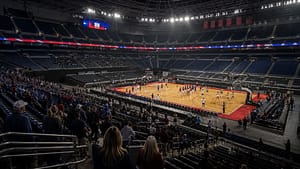
Keldon Johnson’s return to Laredo on August 9, 2026 was more meaningful than another offseason appearance by an NBA player. For young athletes in South Texas, the San Antonio Spurs forward brought a professional basketball experience directly into a market that sits well outside the daily orbit of an NBA arena, major college program or nationally recognized training center.
Johnson hosted the Sixth Man Experience at Border City Sportsplex from 10 a.m. to 2 p.m., marking the third consecutive year he has traveled to Laredo for a basketball camp. The event was open to young athletes and included skill work, shooting competitions and direct interaction with Johnson.
That continuity matters. One NBA appearance can generate excitement. Three straight years begin to create an expectation that South Texas athletes deserve recurring access rather than occasional attention.
Johnson arrived with greater basketball credibility than in his previous visits. He was named the 2025–26 NBA Sixth Man of the Year after averaging 13.2 points and 5.4 rebounds per game for San Antonio and setting a franchise record with 1,081 points off the bench.
For Laredo players, that meant working in the same gym as someone who had just completed the most productive bench-scoring season in Spurs history.
A Third Straight Camp Creates More Than A Celebrity Appearance
The value of Johnson’s Laredo visit begins with repetition.
The 2026 Sixth Man Experience in Laredo was not his first trip to Border City Sportsplex. Johnson had already worked with Border City Hoops in the city during the previous two summers, turning the event into a recurring part of the local basketball calendar.
That distinction matters for youth development.
A one-day camp cannot replace a season of coaching, strength work, repetition and competitive games. Its value comes from exposure. Young players can see the speed at which an NBA athlete performs basic movements, how seriously footwork is treated and how simple skills are repeated at a professional level.
Returning annually gives that experience a stronger local connection. A player who attended as an elementary-school athlete can come back older, stronger and more experienced. Families become familiar with the event. Local coaches can use the visit as another point of motivation inside their regular programs.
Johnson’s growing stature increases the effect. His 2025–26 season made him one of San Antonio’s most recognizable veterans at a time when the Spurs returned to the NBA’s upper competitive tier.
The camp gave young South Texas players access to a current NBA award winner without requiring a trip to San Antonio, Dallas, Houston or another major basketball market.
Laredo Has A Large Youth Population To Serve
Access matters more when the local youth population is substantial.
The U.S. Census Bureau estimated Laredo’s population at 269,515 on July 1, 2025. People under 18 represented 31.3% of the city’s population, a significantly large youth segment for local sports organizations, schools and training programs to serve.
Those figures give basketball development a practical audience.
The latest Census data for Laredo show why youth sports opportunities carry added weight in the city. Laredo is not a small stop where an NBA camp reaches only a limited local base. It is a major South Texas community with tens of thousands of school-age residents.
Geography creates another part of the access issue.
Most elite basketball events in Texas cluster around major metropolitan areas such as Dallas-Fort Worth, Houston, Austin and San Antonio. Families living in Laredo often face longer travel commitments when seeking high-level tournaments, college games, specialty training or professional basketball experiences.
Travel is already part of competitive youth basketball. Families drive for weekend tournaments, club events and showcases. Yet every additional trip adds fuel costs, hotel expenses, meals and time away from work or school.
Bringing instruction and professional exposure into Laredo reduces at least one of those barriers.
A four-hour camp will not equal months inside a high-level development program. It can give players access to an experience that would otherwise require a full family trip outside the city.
Johnson’s Sixth Man Season Gives The Camp A Useful Development Lesson
Johnson’s value to young players extends beyond his NBA status.

His 2025–26 season offers a useful lesson about role development.
Johnson spent earlier parts of his Spurs career as a starter and higher-volume scorer. His role changed as San Antonio built around Victor Wembanyama, De’Aaron Fox, Stephon Castle and Dylan Harper. Rather than allowing a reduced starting role to diminish his impact, Johnson became one of the NBA’s most productive reserves.
The NBA named him 2025–26 Sixth Man of the Year after he played all 82 regular-season games off the bench. He averaged 13.2 points and 5.4 rebounds in 23.3 minutes, shot 51.9% from the field and recorded 1,081 bench points.
He became only the second Spur to win the award, joining Manu Ginóbili from the 2007–08 season.
That career adjustment has direct relevance to youth basketball.
Young players often equate development with scoring more points or moving into the starting lineup. Johnson’s season provides a different model. A player can become more valuable by accepting a specific role, improving efficiency and producing consistently inside fewer minutes.
Camp instruction can reinforce that point. Shooting competitions attract attention, but professional basketball depends on much more: conditioning, rebounding, decision-making, transition effort and the willingness to contribute without controlling every possession.
Johnson is a credible person to communicate that message after turning a bench role into the best individual award of his NBA career.
Border City Sportsplex Is Building A Local Access Point
Johnson’s camp fits into a broader pattern at Border City Sportsplex.
The Laredo facility has worked to bring recognizable basketball figures into the city rather than asking local players to leave South Texas for every major experience.
Border City Sportsplex owner J.O. Alvarez and Border City Hoops have organized camps involving professional players and trainers, creating a local setting for skill development and basketball events.
That approach matters most when the headline appearances support an existing training culture.
The facility cannot build a development pipeline around NBA visitors alone. Young athletes need year-round coaching, competition, strength training and consistent gym access. High-profile camps work best as additions to that structure rather than substitutes for it.
Johnson’s repeated participation gives the facility more credibility with families. His return suggests a relationship with Laredo rather than a one-time booking.
The format of the August 9 camp reflected that balance between instruction and enjoyment. Participants received access to basketball activities and competitions including hot shot, free throw, knockout and three-point shooting contests.
Those games are familiar to youth players, yet they test useful fundamentals under pressure. Free throws require repeatable mechanics. Three-point competitions test footwork and shooting rhythm. Knockout requires quick recovery after misses.
A professional player’s presence can make those simple exercises feel important without turning the event into an unrealistic showcase.
Laredo’s Competitive Youth Results Show There Is A Pipeline To Support
The argument for more South Texas basketball access becomes stronger when local teams are already competing successfully outside the region.
In July, Laredo’s Elite LTX fourth-grade boys team won the Las Vegas Grand Finale after going 4–0 at the tournament. Elite LTX defeated IE Elite of Fontana, California, 40–38 in the championship game.
The team finished its season with a 63–3 record under head coach CJ Martinez and assistants Mat Duron, Andy Pompa and JJ Gomez.
That Elite LTX championship run offers useful context for Johnson’s visit. South Texas basketball does not lack athletes willing to compete or families willing to travel. The challenge is creating more high-level opportunities closer to home.
Elite LTX competed against teams from Laredo, San Antonio, the Rio Grande Valley and beyond. Its trip to Las Vegas shows how far a serious youth program may travel to test itself against different competition.
Johnson’s camp works in the opposite direction: the higher-level basketball experience travels to Laredo.
Both approaches matter.
Strong programs need opportunities to leave their normal competitive environment. Players benefit from seeing new opponents, officiating styles and levels of athleticism. They should not need to leave South Texas for every meaningful training experience.
The healthier development system combines local infrastructure with selective travel.
NBA Access Can Make The Development Path Feel More Real
Professional basketball can appear distant to young players who experience it mainly through television and social media.
An NBA player standing on a local court changes that perspective.
A young athlete can compare Johnson’s size, movement and shooting mechanics with what they see in their own practices. Coaches can point out how professional fundamentals differ from the exaggerated moves that dominate online highlight videos.
That type of exposure should remain realistic.
A camp with an NBA player does not make participants college prospects. It does not change recruiting rankings or guarantee future basketball opportunities. Young athletes develop at different rates, and very few reach professional levels.
The useful takeaway is simpler: the skills shown on television are built from familiar fundamentals.
Johnson still has to balance, plant, shoot, defend, rebound and finish through contact. Seeing those skills up close can make practice concepts more concrete.
His role with San Antonio strengthens that lesson. Johnson’s career has required him to change his responsibilities as the Spurs’ roster changed. Adaptability became part of his development.
For coaches working with South Texas athletes, that can reinforce a valuable idea: player development is not limited to adding new moves. It includes learning how to remain productive when a team asks for something different.
The $85 Camp Price Shows Why Broader Access Still Matters
The Sixth Man Experience cost $85 per athlete.

Participants received a camp shirt, an autographed photo, a personal photo with Johnson, access to competitions and the basketball experience itself.
For some families, that price provides reasonable value for four hours with an NBA player. For others, registration fees can remain a meaningful barrier, especially when several children participate in sports or when families already pay club fees, tournament travel and equipment costs.
That does not diminish the camp. It shows why South Texas basketball access cannot depend exclusively on paid specialty events.
School programs, recreation leagues, nonprofit organizations and community partnerships remain important. Free clinics and low-cost events can reach players who may never participate in travel basketball or private training.
Johnson has participated in several community basketball activities around the San Antonio region, and his Laredo presence can become more valuable if it encourages additional organizations to bring events south.
Professional teams can support coaching clinics. Colleges can stage youth sessions. Local sponsors can fund registrations. Tournament organizers can bring stronger fields into South Texas.
Each step reduces the idea that serious basketball development must happen somewhere else.
South Texas Needs More Events That Come Back
The strongest part of Keldon Johnson’s Laredo camp is not that an NBA player visited the city.
It is that he returned.
Three consecutive years begin to create continuity. Border City Sportsplex can build around that continuity. Local coaches can connect it with year-round training. Families can anticipate the event rather than discovering it as a one-time appearance.
That is how access becomes part of a basketball culture.
Laredo already has evidence of competitive youth programs capable of succeeding outside the region. It has a large youth population and families willing to invest time in sports. What it needs is a steady flow of high-level opportunities that complement those local efforts.
Johnson cannot create that system by himself. His camp can show what it looks like when part of the professional basketball community comes directly to South Texas.
The long-term test is whether more organizations follow the pattern.
If NBA players, trainers, college programs and tournament operators continue treating Laredo as a basketball destination rather than a distant edge of the Texas market, young athletes will gain more chances to learn without beginning every experience with a highway trip north.
Johnson’s August 9 camp lasted four hours. Its larger value comes from the possibility that South Texas basketball access becomes less temporary every time events like it return.