
Imagine the Great Depression hitting America hard. In 1933, Texas politicians found a way to make money: parimutuel betting. Suddenly, four major tracks were allowed to operate. It seemed like a quick fix, but it wouldn’t last.
By 1937, Governor James V. Allred put an end to it. Texas went into its own sports betting prohibition. The Professional and Amateur Sports Protection Act made things even worse, starting a 26-year ban in 1992.
That’s twice as long as alcohol prohibition! But Texans didn’t stop betting. They found new ways to gamble. The state even introduced its lottery in 1992. It seemed like gambling was okay if the government got a piece of the action.
Our texas gambling timeline shows a lot of ups and downs. Texas has always had a complicated view on gambling. Let’s dive into how this all started.
Key Legislation Timeline
If Texas gambling legislation were a reality show, we’d need a scorecard and Dramamine. The rollercoaster ride of our texas betting history is like a political thriller. It has more twists than a Texas two-step.
Our story starts in 1960 with Virgil “Red” Berry. He was a man with a name that sounds like he should be dealing cards. Berry came into office wanting parimutuel betting, showing Texans have debated betting for a long time.
The 1987 parimutuel referendum passed after many tries. We had failed in 1962, 1968, 1974, and 1978. It’s like we treat voting on gambling like our chili recipes – keep trying until you get it right.
In 1992, we did something odd. While PASPA banned sports betting nationwide, Texas started its own lottery. It’s like saying you’re against something while doing the opposite.
The 2018 Supreme Court decision was like watching a party from outside. Texas realized other states were getting into sports betting while we were left out.
2021 saw HB 1121, our first serious sports betting bill. It didn’t go anywhere fast. By 2023, we had bills pass committees but got stuck. It’s like watching a slow-motion rodeo where the bull almost throws the rider but doesn’t.
In 2025, Governor Abbott approved something new. This might be the end of our long wait – or just another pause in our political drama.
This long journey shows Texas moves at its own pace, even with gambling laws. The real question is when sports betting will arrive, not if.
Impact on Local Sports
Texas sports teams are in a game of political chicken, with billions of dollars crossing state lines. The situation is as thick as brisket at a Sunday cookout. Dallas Cowboys owner Jerry Jones has already bet with Oklahoma’s WinStar Casino. At the same time, Mavericks and Rockets owners are cheering for legalization like it’s the fourth quarter of a playoff game.
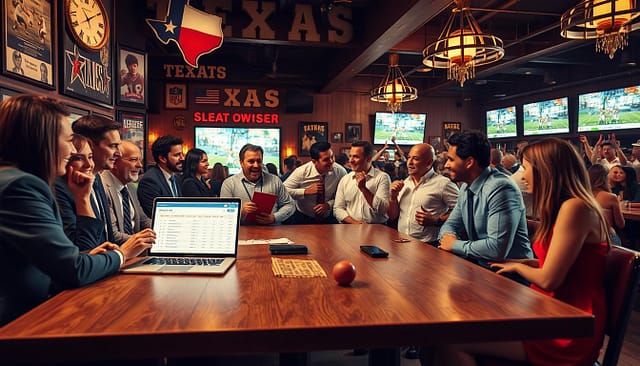
We have 12 professional teams and nearly 30 million passionate residents. Our sporting culture is as deep as our oil reserves. Yet, we live in a strange world where betting is known but not officially acknowledged. The $150 billion illegal market thrives while politicians turn a blind eye.
Fans go to Louisiana or New Mexico to bet legally, then return home to watch games where betting is illegal. It’s like having the world’s best steakhouse but only smelling the smoke. The economic loss is huge – we’re funding other states’ education while ours misses out on $15 billion.
The texas betting history is like a Shakespearean tragedy with better barbecue. Our teams, fans, and economic numbers all want it. Yet, we’re the largest state watching others play the game.
This odd texas gambling timeline has created a “wink wink, nudge nudge” situation in sports. Everyone from team owners to beer vendors knows the truth, but our laws pretend not to see. So, Texas sporting events become places of polite fiction, where what happens on the field stays hidden, and what happens in betting stays secret.
Recent Reform Efforts
If Texas gambling reform were a reality show, the 2023-2025 season would be its most dramatic yet. It would have cliffhangers, surprise twists, and enough political drama to make House of Cards look like Sesame Street.
The 2023 session brought us HB 1942 and HB 2843, two bills that passed the House State Affairs Committee. This was like watching someone assemble the first piece of IKEA furniture correctly. But then, the legislative quicksand kicked in. Both bills got postponed faster than a Houston summer rainstorm.
Enter 2025, when Governor Abbott dropped his bombshell on a podcast. He publicly approved of legal sports betting, admitting Texans are betting already. Why not tax it? This was like your strict parent admitting they knew about your hidden candy stash all along.

Then February 2025 delivered the mic drop moment. Senator Carol Alvarado introduced Senate Joint Resolution 16. This isn’t just sports betting; it’s the full Monte Carlo treatment. We’re talking up to seven destination resort casinos with retail sports betting. This isn’t a half-measure; it’s the whole enchilada.
The catch? This ambitious proposal needs two-thirds approval in both legislative chambers. Then it goes to voters for final approval. It’s like trying to get a group of Texans to agree on barbecue sauce – possible, but requiring near-miraculous consensus.
These recent developments represent a fascinating chapter in the texas betting history that shows how the political winds are shifting. What once felt like a doomed effort now has genuine momentum, though as recent setbacks show, the path remains challenging.
| Legislative Effort | Year | Status | Key Features |
|---|---|---|---|
| HB 1942 | 2023 | Postponed | Sports betting framework |
| HB 2843 | 2023 | Postponed | Expanded gambling options |
| Governor’s Support | 2025 | Public endorsement | Sports betting legalization |
| SJR 16 | 2025 | Introduced | Resort casinos + retail sports betting |
The current texas gambling timeline reveals a pattern: incremental progress followed by dramatic leaps. The 2023 bills represented cautious steps forward. The 2025 developments feel like someone decided to sprint instead of shuffle.
What makes this chapter of texas betting history so compelling is the shifting political calculus. When the governor and key legislators start aligning, it stops feeling like political theater and starts feeling like genuine momentum.
The reform efforts have evolved from scattered attempts to something resembling a coordinated strategy. It’s not perfect – this is Texas politics, after all – but the pieces are starting to fit together in the broader texas gambling timeline.
What’s Next?
Texas is at a crossroads, much like a cowboy at a fork in the road. The state’s texas betting history has seen ups and downs. But, new people keep coming, changing the game.
These newcomers see gambling as fun, not wrong. They’re not stuck in old ways. They’re checking sports bets on their phones instead.
The numbers show a big market waiting: $15 billion. But Texas isn’t tapping into it. This lost money is going to offshore sites and local bookies.
Even if sports betting is allowed, casinos need a big change. We might be able to bet on the Cowboys but need to go to Louisiana for blackjack. It’s a weird mix.
The 2025 session is our chance to catch up with the times. But it’s not just about games. It’s about money versus old beliefs.
| Potential Outcome | Economic Impact | Political Hurdles | Timeline |
|---|---|---|---|
| Sports Betting Only | $2-3 billion annually | Republican resistance | 2025-2026 |
| Full Casino Gaming | $15 billion market | Constitutional amendment | 2027+ |
| Status Quo | Lost revenue continues | Morality arguments prevail | Ongoing |
What’s next in our texas gambling timeline? More politics, yes. More people wanting change, definitely. But, reality will catch up. You can’t fight billions of dollars forever.
The big question is when Texas will accept gambling. And how much money we’ll lose waiting. The texas betting history chapter being written now might show that fighting it was the biggest risk.
Texas in the National Landscape
Texas is like that friend who shows up late but expects applause. Our neighbors in Louisiana, New Mexico, and Arkansas built casinos to attract Texas money. But we stayed away, like a screen door on a submarine.
The Supreme Court’s 2018 decision let sports betting flow in over 30 states. But Texas missed its chance. California moves slowly, but Texas is even slower, debating morality while others make money.
Our history in gambling is like a giant sleeping. When we wake up, we’ll say we meant to sleep in. The whole US sees Texas as a huge opportunity, worth 10% of the betting industry.
Today, Texas is the only state holding out on gambling. It’s as American as apple pie. The irony is clear to everyone watching.