
The Alamodome remains the home of the UIL boys’ and girls’ basketball state championships, but Texas basketball’s most important high school event is approaching a decision point.
UIL director of athletics Ray Zepeda and executive director Jamey Harrison said in July 2026 that they believe the league has two years remaining on its agreement with the San Antonio venue. That keeps the championships at the Alamodome through at least the 2027–28 school year, yet UIL officials are speaking with other venues and evaluating what the event should become after the contract expires.
The question is larger than which arena offers the most seats. A venue change could alter championship atmosphere, statewide travel, ticket demand, hotel costs, court configuration and the way players experience the final game of their high school careers.
San Antonio has hosted the tournament since 2015 and has built a dependable operational model around it. The uncertainty begins with whether dependability is enough, or whether the UIL now wants a basketball-specific building that feels fuller, places spectators closer to the court and better reflects the scale of high school championship attendance.
The Alamodome Remains Secure In The Near Term
The UIL has not announced a relocation, and the next tournament cycle remains tied to San Antonio.
The league’s published schedule places the 2027 girls’ state championships at the Alamodome from March 4–6. The boys’ championships are scheduled for March 11–13 at the same venue. Both events will feature title games across Classes 1A through 6A, with Division I and Division II championships in every classification.

That creates 12 girls’ championship games and 12 boys’ championship games across two three-day events. The format places a large operational burden on the host venue, which must handle team access, locker rooms, media areas, repeated ticket sessions, court changes and spectator turnover.
The Alamodome has experience with that workload. It has enough surrounding event space, a roof that removes weather concerns and a large seating inventory that prevents the UIL from facing capacity problems during heavily attended championship sessions.
The official 2027 boys’ championship schedule confirms that San Antonio remains the immediate destination for qualifying teams. The corresponding girls’ schedule provides the same certainty one week earlier.
Families, coaches and school districts can continue planning around San Antonio for the next cycle. The long-term question begins after the existing agreement ends, not before the next state tournament tips off.
The Alamodome Solved Problems Austin Could Not
The UIL did not move the tournaments to San Antonio in 2015 because the Frank Erwin Center had failed as a basketball venue. The move was driven by availability and affordability problems around Austin.
The state tournaments had a long association with the University of Texas and the state capital. The Frank Erwin Center hosted the event for decades, but the boys’ tournament regularly overlapped with South by Southwest. Hotel availability and rising lodging costs created difficulties for teams, families and supporters traveling from across Texas.
The UIL announced the Alamodome move in July 2014 after staff members searched for a venue that could deliver a stronger overall experience without creating the same hotel pressure. San Antonio offered a large indoor building, a major tourism district and enough lodging capacity to absorb two championship weekends.
The league’s original Alamodome announcement framed the move around the needs of student-athletes, coaches and fans. Those priorities remain relevant to the next venue decision.
A basketball-specific arena may create better sightlines, but the surrounding city must handle thousands of visitors at workable prices. A more central location may shorten travel for some schools and extend it for others. A newer building may look better on television yet offer fewer available dates.
The next host must solve the full tournament problem, not merely provide a court and enough seats.
The Championship Atmosphere Is Driving The Debate
The strongest argument against the Alamodome is not that it cannot host basketball. It is that the building can feel oversized for the attendance generated by many UIL championship sessions.
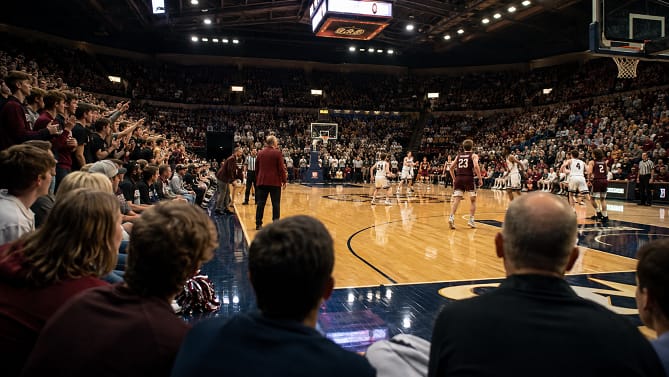
The Alamodome was designed as a large multipurpose stadium rather than an intimate basketball arena. Curtains and covered seating sections reduce its operating capacity for the state tournament, but the building’s scale remains visible. Upper seating areas, long distances from the court and open visual space can make a crowd of several thousand feel smaller than it would inside a 12,000-seat arena.
Attendance reported from the 2026 tournaments averaged approximately 5,343 spectators per boys’ session and 2,573 per girls’ session. Those crowds could create a strong environment inside a smaller basketball building, particularly if seating begins closer to the playing floor.
Galveston O’Connell athletic director and boys’ basketball coach Derek Martin told Chron that San Antonio had done a good job hosting the tournament, but he did not consider the Alamodome the best venue for high school basketball. Other coaches expressed interest in a building with a more traditional arena atmosphere.
The Texas coaches’ venue debate included suggestions such as Dickies Arena in Fort Worth, Toyota Center in Houston, American Airlines Center in Dallas and Moody Center in Austin. Those buildings have not been identified by the UIL as a formal shortlist. They illustrate what some coaches want: closer seating, stronger acoustics and a setting that looks full during championship games.
The counterargument carries weight. Reaching the Alamodome feels different from entering a smaller regional arena. Its scale can reinforce that a team has reached the final stage of a statewide competition. The building has hosted NCAA Final Fours, major football games and national events, giving players a championship platform that smaller venues may struggle to match.
Geography Could Shift The Competitive Experience
Any move would change the travel burden across Texas.
San Antonio is well positioned for schools from South Texas, the Rio Grande Valley, Central Texas and parts of the Gulf Coast. Teams from the Dallas-Fort Worth area, the Panhandle and far West Texas face longer drives. A move north could improve access for the large number of successful programs based in Dallas-Fort Worth but increase costs for communities closer to San Antonio.
The 2026 championship field showed how uneven regional representation can become. Only Fredericksburg on the girls’ side and San Antonio Brennan on the boys’ side represented the broader San Antonio area in the state finals. Dallas-Fort Worth and Houston-area programs supplied a large share of the remaining field.
That distribution can change from year to year, so the UIL cannot select a host based on one tournament’s qualifiers. The league must consider where participating schools have historically come from, where population growth is occurring and how a location affects travel across all classifications.
A Class 6A program from a major district may have a larger travel budget and more support infrastructure than a Class 1A school making a rare championship appearance. Hotel prices, bus transportation, meals and missed school time can create very different pressures across the field.
For readers following statewide Texas basketball championship coverage, the venue question is inseparable from competitive access. A state tournament should feel reachable to programs from every region, even though no single city can provide equal travel conditions for all of them.
The UIL’s challenge is to choose a location that does not repeatedly favor one cluster of schools at the expense of the broader state.
A Smaller Arena Could Improve The Basketball Product
A move into a basketball-first venue could improve several parts of the event without changing the competition itself.
Closer lower-bowl seating would make school sections more visible and place crowd noise nearer the court. Better basketball sightlines would help families follow the action without relying heavily on video boards. A tighter building could create a stronger television image, especially during lower-classification and weekday sessions.
The court setup matters to players, too. Depth perception can change inside a football-scale dome where large spaces sit behind each basket. Teams receive practice and warmup time, but most players reach the state championship without extensive experience in a building of that size.
A traditional arena offers a visual environment closer to the gyms and college venues teams encounter during the playoffs. That familiarity could reduce the adjustment involved in the championship game, though every finalist faces the same court conditions at the Alamodome.
Smaller does not automatically mean better. Dickies Arena, Moody Center, Toyota Center and American Airlines Center maintain busy professional, college and entertainment calendars. The UIL needs consecutive dates for girls’ and boys’ events, extensive setup time and predictable access years in advance.
Frost Bank Center could allow the tournament to remain in San Antonio and move into an NBA building, but the Spurs’ schedule and arena operations would make long-range coordination difficult. The venue may face further uncertainty as San Antonio studies a possible downtown Spurs arena and the future of the current East Side building.
A successful bid must combine basketball atmosphere with scheduling control. The UIL cannot build its championship calendar around a venue that may become unavailable when professional or college dates change.
Tournament Format May Matter As Much As The Building
Some Texas coaches believe the loss of the state semifinal round has affected the tournament atmosphere more than the Alamodome itself.
The UIL expanded basketball into split divisions across all classifications, increasing the number of state champions. Under the current system, regional finals determine which teams advance to San Antonio. The Alamodome hosts championship games rather than the traditional four-team state bracket that included semifinals and finals.
That change reduces the number of participating teams gathered in the host city at one time. It removes semifinal crowds, shortens many families’ stays and changes the feeling of a tournament weekend into a sequence of title games.
Bringing semifinals back would create more games, more traveling schools and more spectators, but it would increase missed class time, hotel demand, officiating needs and venue costs. It could make a smaller arena feel busier, yet it would require a larger operational commitment from the UIL and participating districts.
Martin argued that restoring a Final Four format could do more for the event’s identity than changing arenas. That position deserves attention. A new building cannot recreate the experience of multiple semifinalists arriving in one city if the competition structure sends only two teams from each division.
The UIL must decide which issue it is trying to solve. A venue change can improve sightlines and crowd density. A format change can restore a broader tournament atmosphere. Combining both would represent a major redesign rather than a simple relocation.
San Antonio Still Has A Strong Case
The Alamodome’s weaknesses are visible, but San Antonio retains advantages that rival cities must match.
The city has hosted the event for more than a decade. Tournament staff, hotels, transportation providers and local organizers understand the schedule. Teams can stay near the downtown tourism district, and families have entertainment and dining options between sessions.
San Antonio’s basketball identity extends beyond the building. The Spurs give the city a long professional tradition, and the area produces competitive high school programs across multiple classifications. The tournament has become part of the city’s March sports calendar.
The UIL’s public comments have acknowledged that the Alamodome has treated teams and players well. Zepeda praised the venue’s work before explaining that the league continues conversations with other potential hosts. The reported UIL venue review appears focused on comparing experiences rather than reacting to an operational failure.
San Antonio could retain the tournament through a renewed Alamodome agreement, a different seating configuration or a future move to another local arena. The city’s case should focus on the complete experience: hotel capacity, predictable dates, team services, event staffing and the prestige attached to reaching the building.
The Alamodome does not need to resemble a packed NBA arena to remain viable. It does need to show that its scale strengthens the championship rather than diminishing it.
What The UIL’s Next Venue Decision Must Protect
The future of the UIL basketball state tournament should be judged from the perspective of the teams that reach it.

Players need a court worthy of a state championship, clear scheduling and a building that makes the event feel important. Coaches need dependable practice, locker-room and arrival procedures. Families need manageable hotels, parking and ticket access. Schools need travel costs that do not turn a championship appearance into an excessive financial burden.
The Alamodome meets many of those requirements, which explains why it has remained the host since 2015. Its size and basketball atmosphere remain the central concerns, particularly during sessions that would feel louder and fuller inside a smaller arena.
A move to Fort Worth, Dallas, Houston or Austin could improve crowd density and shorten travel for some of the state’s strongest basketball regions. It could create new hotel conflicts, scheduling problems and longer journeys for South Texas programs. Remaining in San Antonio could preserve operational stability but leave the same atmosphere debate unresolved.
The uncertainty gives the UIL time to define its priorities before requesting or evaluating serious venue proposals. The league should compare attendance, travel patterns, lodging prices, arena availability and feedback from participating schools rather than choosing a city based on prestige alone.
The next decision could determine more than where champions receive their trophies. It could reshape whether Texas’ state finals feel like a collection of games inside a massive stadium or a concentrated basketball tournament built around the athletes, coaches and communities that earned their trip.